
SKU: 308108.v5-ARB
myBaits Expert Angiosperms-353
Enriches 100's of single-copy genes orthologous across all angiosperms (flowering plants)
Description
- Designed by expert plant geneticists
- Demonstrated utility across broad taxonomic range
- Simple, user-friendly data analysis
- Use one bait set across multiple distantly-related taxa
Combining the flexible hybridization power of in-solution target capture with an expertly selected set of orthologous locus sequences, this new probe set has been demonstrated to enrich hundreds of putatively single-copy protein-coding genes across a broad range of angiosperms (flowering plants). Probes were designed from 353 loci, each with 5-15 representative sequences from across all angiosperms which were selected using a novel “k-medoids clustering approach” to maximize taxonomic breadth of the design (Johnson, Pokorny, Dodsworth et al 2019, Systematic Biology).
These probes are broadly applicable for phylogenetic research across all flowering plants, and the kit is available as a catalog product at a low per-reaction cost. As with all myBaits kits, the Angiosperms353 panel is provided as a complete solution target capture kit, including buffers, blockers, and baits, along with an easy-to-use protocol.
Find more information about the design and performance of this probeset in the reference above and the GitHub Repository.
Performance Data
Enrichment of Hundreds of Angiosperm Exons and their Flanking Regions
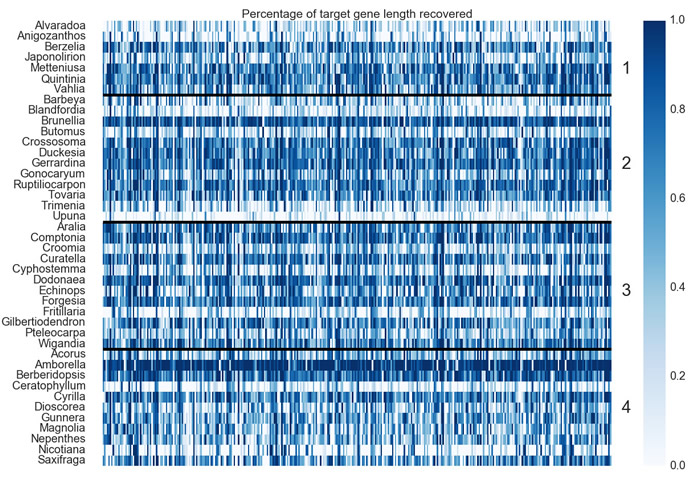
Fig 1. “Heatmap of Gene Recovery Efficiency. Each row is one sample, and each column is one gene. Colors indicate the percentage of the target length (calculated by the mean length of all k-medoid transcripts for each gene) recovered.” (pg 19, Johnson, Pokorny, Dodsworth et al 2019, Syst Bio). Image is Figure 3 from Johnson, Pokorny, Dodsworth et al 2019, Syst Biol.
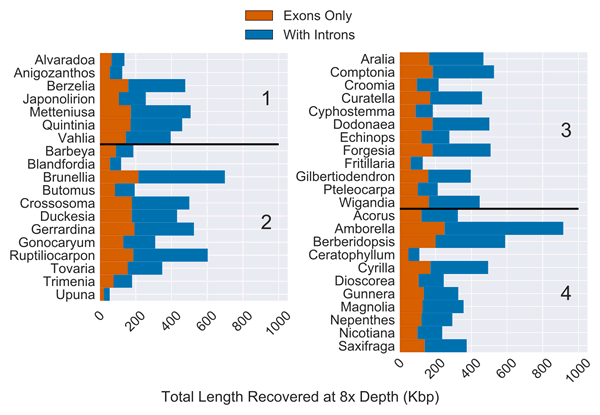
Fig 2. “Total Length of Sequence Recovery for Both Coding and Non-coding Regions Across 353 Loci for 42 Angiosperm Species. Reads were mapped back to either coding sequence (yellow) or coding sequence plus flanking non-coding (i.e. intron) sequence (purple)… The total length of coding sequence targeted was 260,802 bp. The median recovery of coding sequence was 137,046 bp and the median amount of non-coding sequence recovered was 216,816 bp (with at least 8x depth of coverage).” (pg 21, Johnson, Pokorny, Dodsworth et al 2019, Syst Bio). Image is modified version of Figure 4 from Johnson, Pokorny, Dodsworth et al 2019, Syst Bio.