
SKU: NOVA-734100-REV
NEXTFLEX UDI-UMI Barcodes (1-8)
Confident sample indexing - Combine UDI and UMI strategies for accurate NGS multiplexing
Description
NextFlex UDI-UMI barcodes enable you to sequence multiple samples in parallel. The presence of two indices minimizes the effects of index hopping, a phenomenon where a read is assigned to the wrong index as consequence of errors that appear during sequencing process.
Features of NEXTFLEX UDI-UMI Barcodes
- Full length 10 base-pair UDI + 9 base-pair UMI adapters for direct use manually or automated liquid handlers
- Reduced index hopping on Illumina and Element sequencers
- UMI enabled consensus building supports accurate duplicate removal and variant allele detection down to 0.1 % in ctDNA and low input RNA seq datasets
- Drop in compatibility with TruSeq® style library prep chemistries from Revvity, Watchmaker, Illumina®, NEB, KAPA, and Twist, no protocol changes required
- Supports 8–96 multiplexing per lane
The kit arrives as a 96 well plate with 8 uniquely dual-indexed UMI Barcodes. Every well holds a full length adapter pair with a 10 bp Unique Dual Index (UDI) and a 9 bp Unique Molecular Identifier (UMI). The barcode is compatible with standard TruSeq® workflows. Placing distinct 10 base UDI on both ends of every fragment reduces misassignment and index hopping rates below 0.1-0.3 % on Illumina® and Element® flow cells.
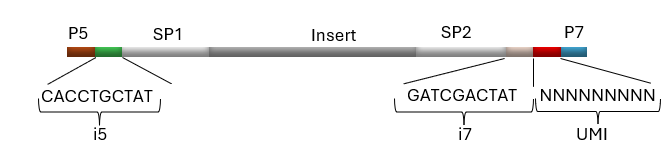
Figure 1. Example of a library containing NEXTFLEX UDI-UMI Adapters, where Insert = DNA or RNA fragment from a sample, P5 and P7 = Flow cell binding sites for Illumina® platforms, SP1 and SP2 = Binding sites for sequencing primers, i5 and i7 = Short pair of 10 bp sequences used to identify a particular sample (UDI), and UMI = 9 bp sequence used to uniquely tag each molecule within a library.
The 9 bp UMI, also known as a molecular barcode, is attached to each original DNA or RNA fragment prior to amplification. During analysis, reads that share the same UMI and map to identical genomic coordinates are grouped together. These groups are collapsed into a consensus sequence, removing PCR duplicates and correcting random sequencing errors.
Because every starting molecule carries a distinct tag, counting unique UMIs after deduplication provides a direct measure of library complexity (i.e., how many unique molecules were captured versus how many were merely re sequenced). This molecular level view supports confident detection of low frequency variants down to 0.1% in ctDNA and low input projects, while ensuring that sequencing depth is translated into true biological coverage rather than inflated duplicate counts.