
Fiber-seq reagents for long-read sequencing with single-molecule epigenetic and genetic profiling
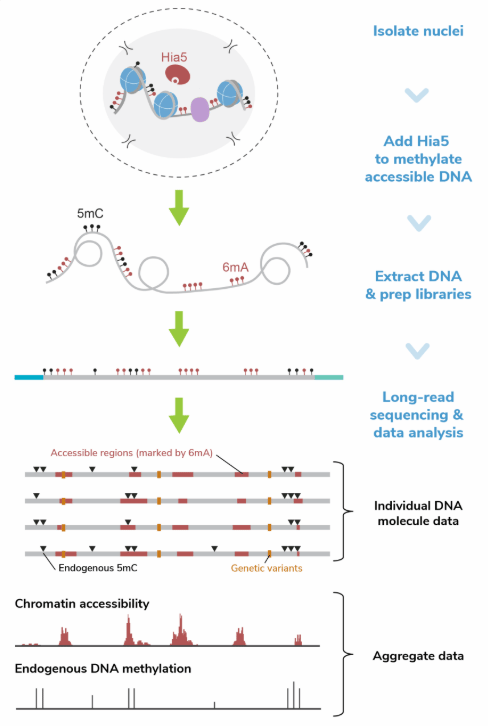
CUTANA™ Fiber-seq combines chromatin accessibility, endogenous DNA methylation and genetic variation in one long-read sequencing experiment. Hia5 N6-adenine methyltransferase labels accessible DNA with 6mA, while native DNA methylation (5mC) is retained. Long reads connect these signals along individual DNA molecules and support the analysis of chromatin structure, protein footprints and haplotype-linked regulation.
Choose the right CUTANA Fiber-seq product
| Product | Choose it for | What to expect |
|---|---|---|
| CUTANA™ Fiber-seq Kit | A guided, complete Fiber-seq assay workflow | Reagents for nuclei labeling and genomic DNA purification, plus a detailed manual and QC guidance. Produces DNA ready for subsequent long-read library preparation. |
| CUTANA™ Hia5 for Fiber-seq | Custom / DIY Fiber-seq workflows | Key 6mA-labeling enzyme for laboratories sourcing or configuring the remaining reagents and purification steps themselves. Follow the separate DIY protocol. |
View the CUTANA Fiber-seq Kit or CUTANA Hia5 for Fiber-seq for product-specific formats and specifications.
How Fiber-seq works
-
Label accessible chromatin. Incubate isolated nuclei with Hia5 and S-adenosylmethionine (SAM). Hia5 introduces 6mA into accessible regions; protected DNA provides information on nucleosome and protein footprints.
-
Purify DNA and prepare long-read libraries. After labeling and DNA purification, use a compatible PCR-free/native DNA library preparation workflow for PacBio HiFi or Oxford Nanopore sequencing. Long-read library preparation and sequencing are separate downstream steps, not part of the Fiber-seq Kit.
- Interpret single-molecule profiles. Analyze introduced 6mA together with endogenous 5mC and genetic variants to study chromatin accessibility, local footprints and variation between DNA molecules or haplotypes.
Applications and experimental planning
Fiber-seq is particularly useful when accessibility and endogenous DNA methylation must be interpreted together on long DNA molecules, including regulatory regions, repetitive or structurally complex loci and allele-resolved questions. Unlike an antibody-targeted assay, protein footprints are inferred from protection patterns rather than directly assigned to a specific protein.
For the standard human-nuclei workflow, EpiCypher recommends approximately one million native nuclei per reaction. Sample preparation, sequencing-platform requirements and workflows for other organisms should be checked against the current product manual and protocol.
Protocols and supporting data
See the EpiCypher Fiber-seq protocols and manuals for the full kit workflow, DIY Hia5 protocol and QC recommendations.
For examples of simultaneous 6mA/5mC detection and protein-footprint analysis, consult the manufacturer’s Fiber-seq technology and performance overview.
The original Fiber-seq method was described by Stergachis et al., Science (2020).
Contact BioCat
Questions? We are here to help. Sales, orders, and general inquiries.
Reach our team for quotes, order status, shipping questions, or anything else related to working with BioCat. We typically respond within one business day.